
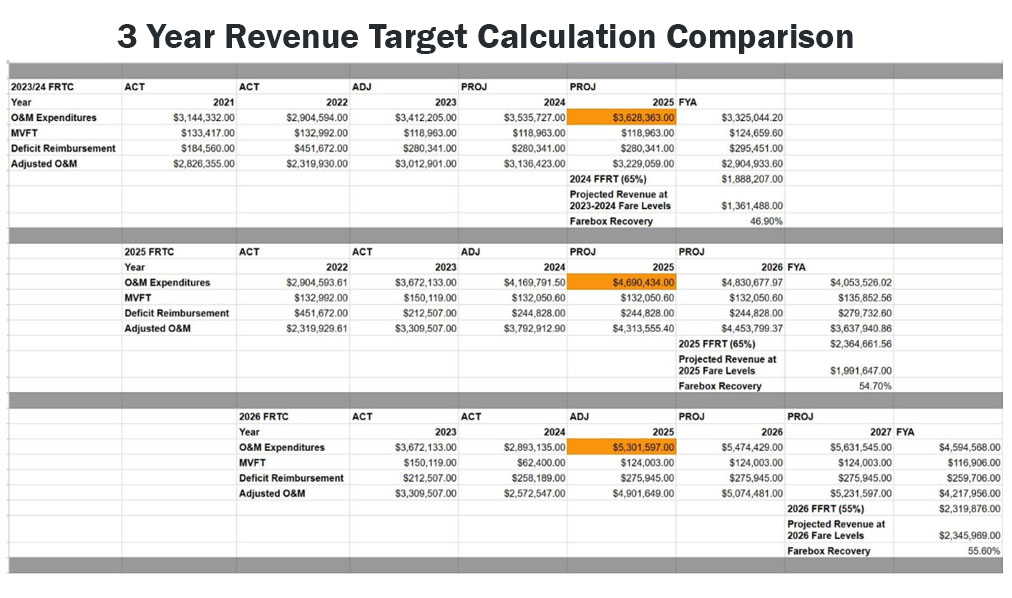


Before we accept a 30% fare increase, We must pause and take a hard look at the budgeting method driving this proposal. When fares are set on projections, those projections must be rock-solid. The 2025 Draft Ferry Fare Target Report (FFTR) doesn’t meet that standard. It lacks the facts, figures, and detail that riders need to make a responsible decision. It’s also inconsistent with other Skagit County budget documents.
We need data that matches reality, not numbers that float.
What We Are Asking
- Delay the 30% fare hike until the County reconciles, documents, and publicly explains the discrepancies in the FFTR.
- Publish a clear, line-by-line reconciliation between the FFTR and the 2024 Approved Budget (Dec 2023) and the 2025–2024 Modified Budget (Dec 2024).
- Include a fare-impact analysis by category (since Aug 2023)—not just total revenue—so you can see exactly who pays what, and how much more.
- Show your work on projections (assumptions, drivers, and sources) and correct mislabeled charts and categories before any vote.

Why This Matters
Since Resolution R20230152 (Aug 2023), fares are pegged to projected budgets. That raises the bar for accuracy and transparency. Last year’s projections missed big: the much-publicized $2,000,000 road fund subsidy “need” was actually $928,156. That’s not a rounding error—that’s a narrative that scared people and didn’t match the books.
The 2025 Draft FFTR now projects the 2026 road fund subsidy at $3,765,986 and an O&M budget of $6,701,579—yet the fare methodology shows $5,474,429 for 2026. Which is it? Riders deserve to see the details that bridge that gap.
The Evidence You Can’t Ignore
On page 23 of the FFTR, the 2024 Expenditure figures don’t match either the 2024 Approved Budget (Dec 2023) or the 2025–2024 Modified Budget (Dec 2024). Here are the categories that jump off the page:
- 3120 – Operating Supplies
- FFTR 2024 Budget: $75,000
- 2025–2024 Modified Budget (Dec 2024): $150,000
- 2024 Approved Budget (Dec 2023): $150,000
- 4110 – Professional Services
- FFTR 2024 Budget: $226,245
- 2025–2024 Modified Budget (Dec 2024): $65,000
- 2024 Approved Budget (Dec 2023): $25,000
- 4154 – Interfund Payment of Service
- Not included in 2025–2024 Modified Budget (Dec 2024) or 2024 Approved Budget (Dec 2023)
- 4510 – Rentals
- FFTR 2024 Budget: $120,648
- 2025–2024 Modified Budget (Dec 2024): $100,648
- 2024 Approved Budget (Dec 2023): $60,000
- 4910 – Miscellaneous
- FFTR 2024 Budget: $139,902
- 2025–2024 Modified Budget (Dec 2024): $62,990
- 2024 Approved Budget (Dec 2023): $62,902
And the Chart of Expenditures in the FFTR is titled “2022 Expenditures,” date-stamped June 11, 2024. If those are June 2024 figures—and the 2025 budget was finalized in December 2024—it stands to reason the FFTR’s 2024 budget should align with either the 2024 Approved or the 2025–2024 Modified numbers. It doesn’t.
The Human Impact You Don’t See in Totals
Totals hide pain points. People feel line items.
Since August 2023, you’ve approved fare changes without a simple, public graph of fare increases by category. Create it. Look at it. Because right now, seniors and disabled riders are being hit hard. A 25-trip senior walk-on will cost $118.50—compare that to $77.50 for 25 senior passes on the Mukilteo–Clinton route. That’s a gut punch to people on fixed incomes who rely on Guemes as a lifeline.
The Bottom Line
You can’t build public trust on fuzzy math. You can’t justify a 30% increase with inconsistent documents, mislabeled charts, and projections that have already proven unreliable. This isn’t about being anti-fare. It’s about being pro-truth.
Do the courageous thing leaders do: pause, reconcile the numbers, show your assumptions, and put the category-by-category fare impacts on the table before you ask riders to pay more.
 Guemesferry.org