


The purpose of this document is to provide information to the residents of Guemes Island and Anacortes about the Anacortes Ferry Terminal Modifications that have been proposed by Skagit County Public Works and are currently under review with the City of Anacortes Planning, Community & Economic Development Department (PCED). City of Anacortes, WA Public Portal
Our goal is to help the residents of Guemes Island and the City of Anacortes understand the potential impacts that this proposal will have on the ferry system and the surrounding communities.
As well, we hope to prepare people to make and submit Public Comment during the 30 day public comment period starting on June 25th 2025 and ending on July 25th 2025.
Please Submit Public Comment! It is very important that we as community members and ferry users submit feedback on this project. These changes will have a lasting impact on the entirety of the ferry service, not just ferry operations, but parking and public safety as well.
Submit Written Comments to: pced@anacorteswa.gov
What to Include: Comments must include your name and address, and should reference the permit number SDP-2024-0003.
Please also copy guemesferry@gmail.com on your comments if you would like to share them with us as well.
All public comment will get reviewed by the applicant: (Skagit County Public Works Ferry Division)
What happens next? Following the close of the public comment period, Anacortes PCED will schedule a Public Hearing. When this is scheduled, we will forward that notification to you.
Proposed Ticket Booth:
The Anacortes ferry terminal project includes a plan for a ticket booth located between the loading and unloading lanes. It will be used to sell and validate tickets. There is currently no need for a ticket booth. As we have experienced with the current implementation of the electronic ticketing system, adding more steps and more infrastructure creates more complexity and confusion in the loading process, and significantly increases the cost due to the need for additional staffing.
The following are specific examples of why the proposed ticket booth will not improve ferry operation:
- Blocks emergency ingress/egress & restricts flexibility for loading and unloading:
- The ticket booth is to be located in the center of the loading lanes. It prohibits flexibility in loading and unloading that is often necessary in emergency situations, accommodating oversized & large vehicles, or other situations that would require anything other than a standard passenger vehicle loading.
- Creates congestion for both vehicles & passengers, reducing efficiency for ticketing, validating, and loading:
- The ticket booth creates a bottleneck for all vehicular and pedestrian traffic. This will increase wait times for passengers, vehicles purchasing tickets and vehicles that have already purchased tickets and require validation. This reduces efficiency and loading time by creating a single point of sale and ticket validation.
- Safety hazard:
- Pedestrians near vehicle lanes is an accident waiting to happen. Having a static ticket booth located in between the loading and unloading lanes creates a hazard for pedestrians. This is increased with the need for all passengers who walk-on to purchase their tickets at the ticket booth in close proximity to vehicles that are potentially lining up and unloading at the same time.
- Unnecessary use of funds:
- There is no benefit to spending the money to build & maintain a ticket booth. With no benefit to loading efficiency, reduction in cost, or reduction in staffing needs, this would just be another expense for both operation and maintenance.
Proposed Ticket Booth Location: Shown without any vehicles in the holding lane or vehicles unloading off the ferry.

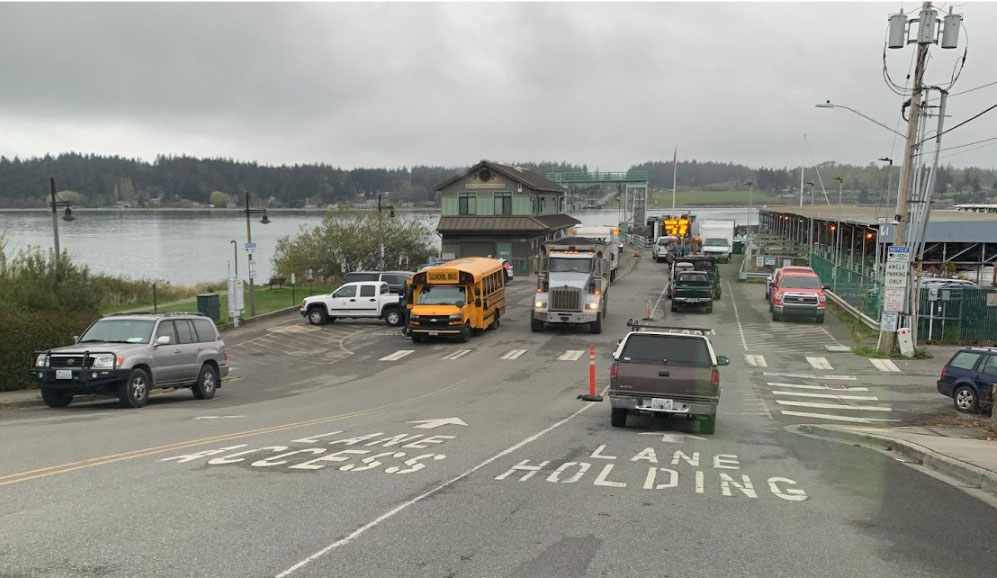
View From Holding Lane : Shown with vehicles in the holding lane, school bus waiting, and ferry unloading.
Proposed Additional Holding Lanes:
The Anacortes Ferry Terminal Project includes plans to modify and relocate the ferry queueing/holding lanes such that more cars will be able to wait for the ferry down at the terminal level. The justification for this new configuration according to the November 14, 2023 Neighborhood Meeting Presentation was: reduced congestion on 6th st. and improved purser safety. Additionally it has been stated that in conjunction with the new ticket booth, this new configuration will allow a larger ferry to load faster because fares will be prepaid for vehicles in this expanded holding area.
The following are some specific examples of why these modifications are unnecessary and will not improve the ferry service:
- There simply isn’t a congestion problem on 6th st. that needs to be fixed:
- Currently there is a dedicated queueing lane on 6th St. that extends 2 blocks West to K Avenue. The addition of queueing at the terminal level will not eliminate the need for this space. Our estimate based on the provided graphic is that this new area will hold 10-15 average sized vehicles max. In its current configuration, the ferry line rarely extends past K Avenue and this is only during peak weekends during peak season.
- The proposed new holding lane configuration squeezes way too much into a small area creating logistical issues for ticketing and loading, as well as safety concerns for staff and customers:
- With holding lanes full, safe evacuation of the terminal area during an emergency will be challenging.
- The holding capacity of the proposed new lanes is insufficient to notably improve loading speed, given that only a partial ferry load will be queued past the ticket booth.
- The purser in the ticket booth may be safer inside, but all passenger traffic will need to purchase tickets at the booth, commingled with vehicle traffic doing the same thing. The current configuration keeps pedestrians separated from vehicle traffic.
- Given the layout of the ticket booth and the holding lanes, there will likely be a need for additional staff to direct parking in the holding area.
- When a vehicle is purchasing a ticket from the booth, their car will most likely block the pedestrian walkway and the entrance/exit to the railroad parking lot. This includes blocking the ADA access between the terminal and parking lot.
- With the new holding lane existing in place of the current “access lane,” there will no longer be access to the 5-minute parking spots to drop people off or unload groceries. The closest passenger drop off will be at the top of the hill on 6th street which will be dangerous for anyone needing ADA access.
- There will be no room for an ambulance to park while waiting for the returning ferry during an emergency, other than somewhere on 6th Street.
- There will be no access to the terminal building any time while the ferry is unloading. If someone unfamiliar with the ferry system was to park close to the terminal building while the ferry was away, they could become an obstruction to unloading if the ferry returned.

Proposed Holding Lane Layout

Example of Busy and Congested Terminal

Example of Busy and Congested Terminal
Proposed Battery/Switch Gear:
As part of the upcoming ferry electrification project, the proposed onshore battery storage and high-voltage charging infrastructure at the 6th Street and I Avenue terminal raises serious safety and environmental concerns that deserve your attention.
Here are some important things to consider about this proposal:
- Location Risks:
- The planned battery installation is within a Tsunami Zone, placing high-voltage equipment and flammable materials in an area exposed to natural disaster risk.
- Locating the electrical infrastructure in the proposed area eliminates several ADA-accessible parking spaces, reducing terminal accessibility for vulnerable members of our community.
- Fire and Explosion Hazards:
Both the car ferry’s onboard batteries and the shore-based battery energy storage system (BESS) carry well-documented risks of lithium-ion battery fires. These can:- Burn at temperatures over 5,000°F
- Emit toxic fumes like hydrogen fluoride and carbon monoxide
- Require massive fire suppression efforts—up to 20,000 gallons of water per incident
- Reignite days after the initial fire is out
- Additional Safety Concerns:
- Explosive gas buildup during battery fires can lead to secondary detonations, like the 2025 Norwegian ferry incident.
- High-voltage charging (400-1,000V) creates lethal arc flash risks without proper disconnects and responder protections.
- Traditional fire methods fail: Water, CO₂, and dry chemicals often can’t stop these types of fires.
- Public Infrastructure Impact:
- Toxic smoke plumes could reach downtown Anacortes.
- Nearby neighborhoods, city streets, and travel to and from Guemes could be compromised during an emergency response.
- Serious Safety and Environmental Concerns:
- The risks of installing this infrastructure in a tsunami and residential zone
- The need for modern fire suppression systems, emergency response protocols, and hazard mitigation planning
- The importance of preserving ADA parking and ensuring accessibility for all ferry users.
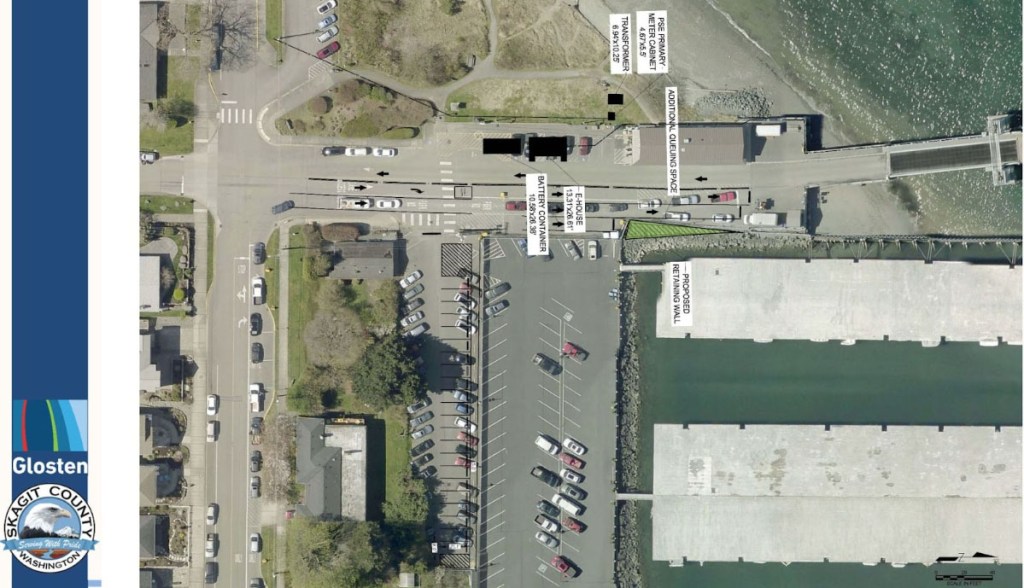
Proposed Battery Location Displaces ADA Parking and Bus Turnaround
“Railroad” Parking Lot Modifications:
The Anacortes Ferry Terminal Project includes plans to modify the Railroad parking lot as pictured below. The stated reasoning for this change is to “improve access and compliance,” and that it will provide ADA upgrades. This does not appear to be true. The following are concerns about this proposed new configuration:
- Removing half (or more) of the spaces:
- The diagram shows a reduction of roughly half the number of existing spaces as only one side of the lot will be used for parking. This will have the effect of pushing 20-22 cars over into the East lot and out into the neighborhoods. This will increase the impact of the ferry operation on the surrounding communities, not just during haulouts and peak season, but year round.
- ADA parking will be located further from the ferry terminal:
- With the proposed addition of the electric ferry charging infrastructure, at least 4 of the 6 existing ADA spots South of the terminal building will be eliminated, creating a need to move them somewhere. This will likely be at the West end of the railroad lot. There is currently no limitation on the distance that ADA spaces must be from the terminal, but this new configuration significantly increases the walking distance, and will now require mobility limited persons to cross loading and unloading traffic to access ADA parking.

Proposed Railroad Lot Configuration
Proposed Dock Modifications
The Anacortes ferry terminal project includes a plan for modifications to the existing ferry dock structure to include widening of the passenger gangway, replacement of the dock apron and modification of wingwalls to accommodate the larger apron. Also included is the construction of a catwalk and platform for maintaining the charging arm.
Concerns with the proposed terminal modifications:
- At the moment, it is still unclear whether or not a replacement ferry is in the cards. Since we still do not have the funding for construction of the 28-vehicle electric ferry, the proposed modifications to the existing dock infrastructure are an unnecessary expense. Based upon the past timeline proposed for the funding and construction of the new ferry, it is unlikely that we will see a new ferry (electric or hybrid) for several years if not more.
- While the permit application states that there will not be an interruption in ferry service during this construction, that is unrealistic when considering the scope of the work directly impacting ferry loading. The replacement of aprons and wingwalls and dolphins all will interrupt ferry operations.
- If passenger safety is a key goal of the project, justifying a widened apron, why place a ticket booth directly in the middle of a crosswalk spanning four lanes of traffic at the heart of a bus turnaround?
- Another goal of the dock modifications is to maintain the 30-minute loading time. Passengers to Guemes Island typically pull loaded carts, bring bicycles, and may have dogs on leash. Some passengers are quite elderly and no amount of modifications short of a people mover are going to increase the speed at which passengers can get from the terminal onto the ferry.

Proposed Dock Modifications
 Guemesferry.org